



Choosing your first padel racket can feel overwhelming. Walk into a sports shop or browse online and you'll find dozens of options, different shapes, weights, materials and prices. But how do you know which one is right for you?
If you're new to padel, the good news is that you don't need the most expensive racket or the latest professional model to get started. What matters most is finding a racket that feels comfortable, is easy to manoeuvre and allows you to learn the game with confidence.
Padel is growing around the world, and more people are discovering the sport in places like Lombok, Indonesia. Some are picking up a racket for the first time, while others are coming from tennis and adapting to a game with different movements, tactics and court dynamics.
Whatever your starting point, choosing the right first racket can make a real difference to your experience.
In this guide, we'll explain the main things to consider when choosing a padel racket for beginners, from shape and balance to weight and materials.
1. Why padel racket balance matters
Balance is one of the most important things to consider when choosing your first padel racket, and it is often overlooked.
It refers to how the weight is distributed along the racket. In simple terms, it affects where the racket feels heavier when you hold and move it.
There are three general types of balance:
Low balance
With a low-balance racket, more of the weight is distributed towards the handle.
This generally makes the racket feel easier to manoeuvre and position. It can help you prepare your shots, adjust your racket position and react more comfortably during fast exchanges.
For beginners, this can be particularly useful.
When you're learning padel, you're already thinking about many things at once: your body position, preparation, contact point, technique, direction and shot selection. You are also still learning how much force to use. Many beginners naturally try to hit the ball harder than necessary, instead of focusing on timing, control and placement.
A racket that is easier to manoeuvre can help you focus on these fundamentals without adding unnecessary difficulty.
Medium balance
A medium-balance racket distributes its weight more evenly.
It can offer a different feel between manoeuvrability and how the racket moves through the swing. Some players prefer this type of balance because it feels comfortable for different situations on court.
Whether it suits you depends on the racket's other specifications and how it feels in your hand.
High balance
With a high-balance racket, more of the weight is distributed towards the head.
This makes the racket feel heavier at the top. It can be more demanding to manoeuvre, position and reposition.
This is particularly important for beginners. When you're still learning the correct technique, using a racket with too much weight towards the head can make it harder to control the racket and execute movements correctly. You may start compensating with your wrist, elbow or shoulder to move and position the racket. Over time, these compensations can increase the risk of overuse injuries and discomfort.
This is one of the main reasons why we recommend low-balance rackets for beginners: they make it easier to develop proper technique without placing unnecessary physical demands on your arm.

2. Understanding the three main padel racket shapes
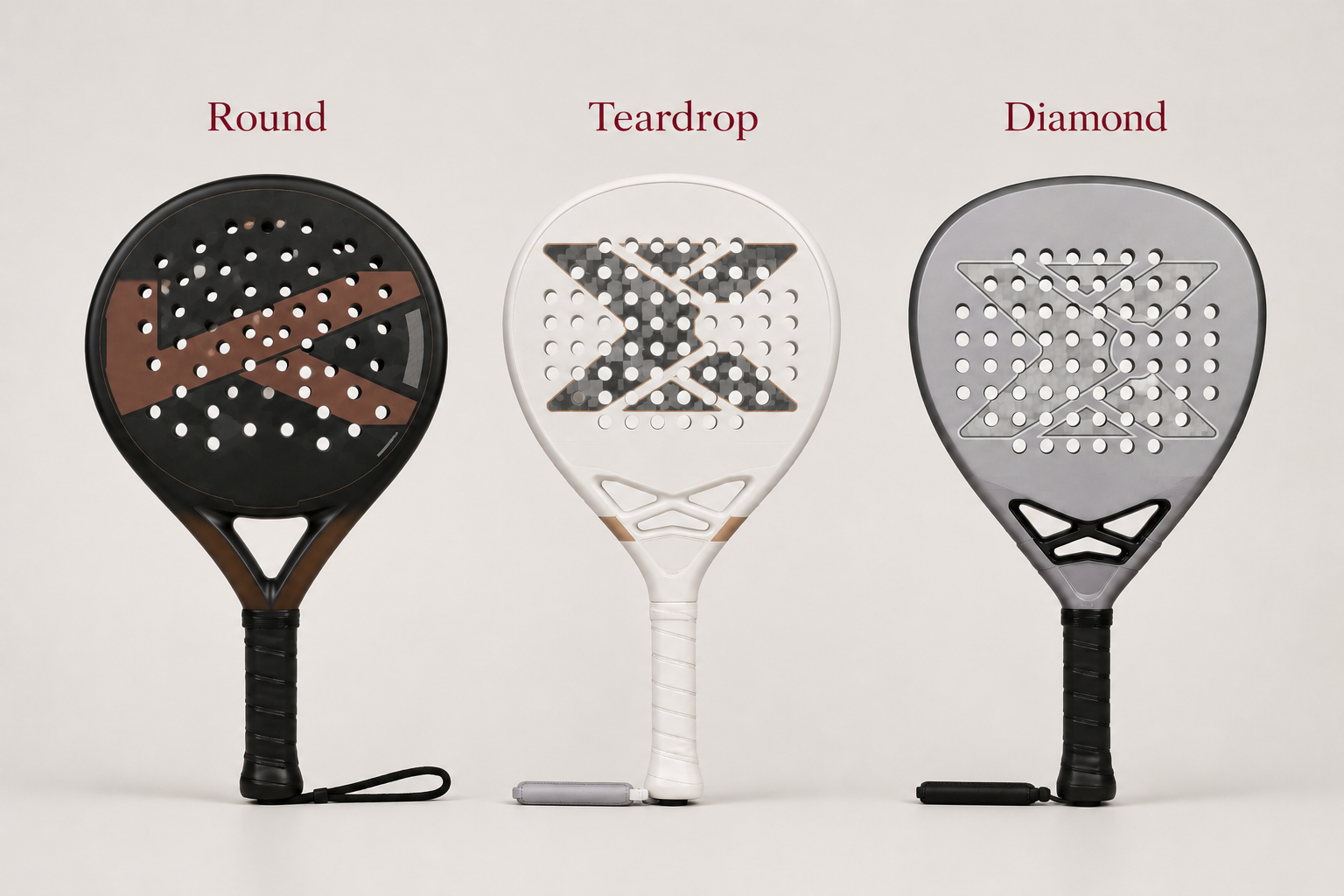
One of the first things you'll notice when looking at padel rackets is that they come in different shapes. The three most common are round, teardrop and diamond.
Each shape has a different design, which influences the position of the sweet spot and is often associated with a different balance. Understanding these differences can help you choose a racket that feels comfortable and suits your level of play.
However, shape and balance are not exactly the same thing. The balance also depends on the racket's construction and specifications, so two rackets with the same shape can feel very different.
Round-shaped padel rackets
Round rackets generally have a sweet spot positioned closer to the centre of the racket.
This can make it easier to find the correct contact point, especially when you're still learning the basics. Their design is often associated with a more forgiving feel, which is one reason why many beginners find them comfortable to use.
Round rackets also tend to have a lower balance, with more of the weight distributed towards the handle.
They are not just beginner rackets, either. Many experienced players choose round-shaped rackets throughout their careers because they suit their technique, preferences and playing style.
Teardrop-shaped padel rackets
Teardrop-shaped rackets have a sweet spot that is generally positioned slightly higher than in round-shaped models.
Their balance often sits somewhere between round and diamond-shaped rackets, although this depends on the individual model. Some teardrop rackets have a relatively low balance and can be perfectly comfortable for beginners, while others feel more head-heavy and demanding.
They offer a different design and playing feel, but that doesn't automatically make them more advanced or better suited to a particular level.
A teardrop racket isn't necessarily the next step after a round one. Many experienced players prefer round-shaped rackets throughout their careers, while others choose teardrop models because they better suit their game.
There is no reason to change racket shape simply because your level improves.
Diamond-shaped padel rackets
Diamond-shaped rackets generally have a sweet spot positioned higher towards the head of the racket. They also tend to have a higher balance, meaning more of the weight is concentrated towards the top.
This makes them feel more head-heavy and generally harder to manoeuvre and position, particularly when you need to react quickly or prepare your shots.
Depending on their construction and specifications, they can also feel less forgiving when contact with the ball isn't clean. Some models are designed with more experienced or attack-oriented players in mind, but the shape alone doesn't tell you everything about how a racket will perform.
For someone just starting out, we wouldn't recommend a diamond-shaped racket as a first choice. The higher balance can make it harder to develop the correct movements and technique, especially when you're not yet used to handling the racket. If your technique isn't well established, having to compensate for that extra weight can also increase physical demands on your wrist, elbow and shoulder.
So, which shape should a beginner choose?
For most beginners, we'd recommend starting with a round-shaped racket with low balance. This allows you to focus on developing your technique without fighting against the weight of the racket head.
A teardrop racket with low balance can also be a suitable option for some beginners. However, we wouldn't recommend choosing a diamond-shaped racket as your first racket.
Remember: shape alone doesn't determine balance. Always check the specifications of the individual racket. A round racket with high balance can still feel demanding, while a teardrop racket with low balance may feel much easier to handle.
3. How much should a beginner padel racket weigh?
Weight is another important factor when choosing a padel racket.
Many adult padel rackets weigh somewhere around 340–370 g, although some models fall outside this range.
A lighter racket can feel easier to manoeuvre, which may be helpful when you're learning to prepare your shots and react to the ball.
A heavier racket may feel more stable to some players, but it can also require more effort to move and position, depending on its balance and overall design.
There isn't one perfect weight for every beginner. Your strength, physical build, experience, comfort and the racket's balance all influence how heavy it feels when you play.
If possible, try holding or testing a few different rackets before making a decision. Pay attention to how easily you can move the racket, prepare your shots and keep it comfortable in your hand.
Remember: the goal isn't to choose the lightest racket available. It's to find one you can handle comfortably throughout a match.
4. Coming from tennis? Here's what you should consider
If you've played tennis before, you may find some aspects of padel familiar. Your hand-eye coordination, racket experience and understanding of basic shots can help you adapt.
However, padel is a different sport, and the transition isn't always as straightforward as it seems.
This is especially relevant for people discovering padel in Lombok. Many new players come from tennis, but the racket that feels familiar from tennis may not necessarily be the best choice for padel.
If you're transitioning from tennis, don't assume that a heavier or more powerful-feeling racket is automatically the right option.
Give yourself time to adapt to the movements and technique of padel. Choose a racket that feels comfortable and allows you to develop the specific skills the sport requires.
5. What about racket materials and hardness?
Padel rackets are made using different materials and construction methods. You'll commonly see references to fibreglass, carbon fibre and different types of foam or EVA rubber in the core.
These materials can influence how a racket feels, its flexibility, stiffness and response when hitting the ball.
However, it's not as simple as saying that fibreglass is always soft or carbon fibre is always hard. The final feel of a racket depends on the combination of materials, the type of fibres used, the core, the construction and the overall design.
As a beginner, you don't need to understand every technical detail before buying your first racket. Start by finding something comfortable and easy to handle. As you gain experience, you can explore how different materials and constructions affect your game and which characteristics you prefer.
We'll explore this in more detail in our guide to padel racket materials.
6. Do you need an expensive padel racket as a beginner?
Not at all.
It's easy to assume that a more expensive racket will automatically make you play better, but that's not how padel works.
Professional and high-end rackets often feature specific materials, constructions and designs aimed at particular playing preferences. However, those features don't necessarily make them the best choice for someone learning the sport.
Instead of buying a racket because it's used by a professional player or has the highest price tag, look for one that offers:
- A comfortable weight.
- A balance that feels easy to manoeuvre.
- A shape that suits your preferences.
- A comfortable feel when making contact with the ball.
- A price that makes sense for your budget.
You can always explore other rackets as your experience and preferences develop. Your first racket should help you enjoy learning the game.
7. How to choose the right first padel racket
If you're still unsure, here's a simple summary of what to look for when choosing your first padel racket.
- Shape: A round racket is often a comfortable starting point, but a suitable teardrop model can also work.
- Balance: Prioritise low or comfortable medium balance for easier manoeuvrability.
- Weight: Look for a weight you can handle comfortably. Many adult models are around 340–370 g.
- Materials: Focus on the overall feel rather than assuming one material is always better.
- Price: You don't need an expensive professional racket to learn the game.
Most importantly, don't choose a racket based only on its shape, colour, price or the level written on the product description.
Two rackets with the same shape can feel completely different because of their balance, weight, materials and construction.
If you have the opportunity, try a few options before buying. Even a short test can help you understand what feels comfortable and natural for you.
8. The most important thing: learn the technique first
Your racket matters, but it isn't what makes you a good padel player.
When you're starting out, the biggest improvements will come from learning the fundamentals: positioning, preparation, timing, contact point, movement and shot selection.
A good racket should support your learning process, not replace it.
Don't rush into buying a professional model or changing rackets because you think you need something more advanced. Give yourself time to understand your game, identify your preferences and discover what works best for you.
The right first padel racket is the one that feels comfortable, allows you to move freely and helps you enjoy the process of learning.
And that's what matters most when you're starting out.
Ready to start playing padel? Choose a racket that feels right for you, focus on learning the fundamentals and, most importantly, enjoy the game.
Frequently Asked Questions
What is the best padel racket for beginners?
For most beginners, a round-shaped racket with low balance and a soft feel is a great starting point. This combination makes the racket easier to manoeuvre, helps you prepare your shots and is more forgiving when you're still learning to make consistent contact with the ball. The goal is to choose a racket that helps you develop the correct technique rather than making the game more physically demanding.
Why should beginners choose a low-balance padel racket?
Low balance means that more of the racket's weight is distributed towards the handle rather than the head. This makes the racket easier to manoeuvre and position, helping you prepare your shots correctly and react to the ball.
More importantly, learning with a manageable racket makes it easier to develop proper technique. A high-balance racket isn't automatically harmful, but when your technique is still developing, the extra weight towards the head can make it harder to control the racket and encourage compensations in your movements. Over time, these compensations can increase the physical demands on your wrist, elbow and shoulder.
That's why we recommend low balance as a starting point: it helps you focus on learning the right movements without fighting against the racket.
Is a diamond-shaped padel racket suitable for beginners?
We wouldn't recommend a diamond-shaped racket as a first choice for someone learning padel. These rackets often have a higher balance, with more weight towards the head, making them harder to manoeuvre and position.
Beginners generally benefit more from a racket that feels comfortable and allows them to develop the basic movements and technique. A round-shaped racket with low balance is usually a much more suitable starting point.
Is a round padel racket always better than a teardrop racket?
Not necessarily. Round rackets generally have a more centrally positioned sweet spot, which can make finding the contact point easier when you're learning. However, shape isn't the only factor. A round racket with high balance can still feel demanding, while some teardrop models have low balance and can be comfortable to use.
Always check the balance and overall feel of the individual racket rather than choosing based on shape alone.
Can I use a professional padel racket as a beginner?
You can, but some professional models have specifications that may feel demanding when you're still learning the basics. A comfortable racket that supports your technique is usually a better starting point.
Does a heavier or head-heavy padel racket give you more power?
No, not automatically. A heavier or head-heavy racket doesn't necessarily generate more power. The result depends on several factors, including your physical strength, technique, and, particularly, the racket's materials and construction.
The type of fibres, core and overall design influence how the racket responds when you hit the ball. A racket that feels heavier or has more weight towards the head may also be harder to manoeuvre, especially if you don't yet have the technique or strength to handle it comfortably.
More weight doesn't automatically mean more power. The right racket is the one that allows you to generate an effective and controlled shot.
Should beginners choose a soft or hard padel racket?
For most beginners, we recommend starting with a softer racket.
A soft racket is generally more forgiving and can help you get a better response from the ball, even when your contact isn't perfectly centred.
A harder racket requires more precision and control over where you impact the ball. If your contact point isn't consistent, it can be less forgiving and make it harder to get the response you're looking for.
As your technique and control improve, you can explore different hardness levels and find the feel that suits your game. But when you're starting out, a softer racket is generally more helpful than one that demands precision you haven't developed yet.
Do I need to buy a new padel racket as I improve?
No. You don't automatically need to change your racket as your level improves. There is no rule that says you have to move from a round racket to a teardrop or diamond shape.
Many experienced players continue using the same racket shape and specifications for years because they suit their playing style. If your racket feels comfortable, supports your technique and allows you to play the way you want, there's no reason to change it just because you've improved.
Consider changing your racket when your physical needs, preferences or playing style genuinely call for something different, not simply because you've reached a higher level.